
Feature Commentary
By Chukwudi George Ozalla

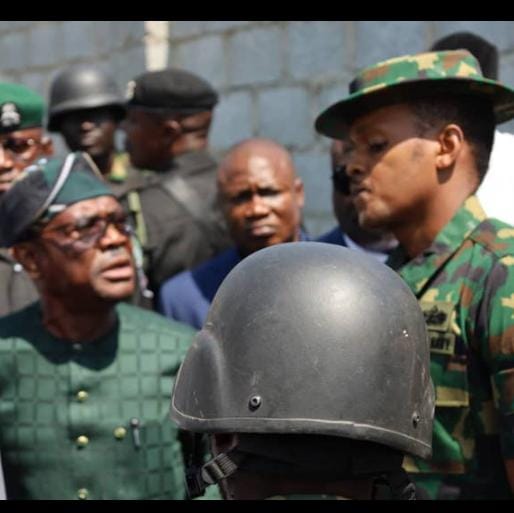
The altercation that occurred yesterday in Gaduwa District of Abuja between the Minister of the Federal Capital Territory, Nyesom Wike, and soldiers guarding a property reportedly linked to a senior military officer has reopened deep questions about authority, discipline, and the rule of law. What should have been a routine enforcement inspection by the FCT Administration turned into a public confrontation between two arms of government, one exercising administrative power and the other bound by military command.
Reports indicate that the Minister’s team was stopped at the site by uniformed men claiming to act on orders from their superior. The exchange, which quickly went viral, exposed a troubling overlap between civilian enforcement and military involvement in matters that fall squarely within civil jurisdiction. It forced Nigerians to ask once again under whose authority soldiers take positions in private properties, and where the legal boundary lies between executive power and military discipline.
Under Nigerian law, the Land Use Act of 1978 vests control of land in state governors to hold in trust for the people. In the case of Abuja, the Federal Capital Territory Act places that authority in the hands of the President, who delegates it to the FCT Minister. These laws give the Minister germane administrative power to allocate, revoke, and reallocate land in the FCT, but such powers are not absolute. They must be exercised within the law, transparently, and with full regard for due process.
Equally, the Armed Forces Act defines the structure, conduct, and discipline of the military. Soldiers are trained to obey lawful orders within a strict chain of command, not to act as private guards for individuals or to interfere in civilian governance. The Constitution is clear on the separation of military and civil authority. When soldiers are deployed to protect property interests, it raises questions about the legality of such orders and whether they reflect institutional command or personal influence.
It is important to remember that once a soldier, always a soldier. Even at very senior levels, before retirement, military personnel enjoy protections and influence arising from their service. They continue to wield informal authority and can protect themselves and their property long after leaving active duty. That context explains why disputes involving military-owned or linked property often take on heightened sensitivity, but it does not place anyone above the law.
If it is easy to sign your readiness for death ahead in defence of the motherland, to know that any day could be your last in the line of duty, then come on board and join the military. That is the life of a soldier: loyalty to command, sacrifice to the nation, and obedience to lawful authority. Civilians must respect those in uniform, even as the military must remember that they are servants of the state, not of private interests.
That respect, however, should never become an excuse for excess or impunity by public officers. Any land matter already before a competent court must be left for judicial resolution. There have been too many instances where lawful injunctions were ignored and enforcement continued as though the courts were irrelevant. This attitude weakens institutions and deepens public distrust. Every dispute or discrepancy in land allocation should be laid bare for citizens to see. Transparency is the only way to restore confidence in governance.
The FCT Minister’s authority over land should not be abused. It is a public trust, not a private privilege. It is particularly germane to recall a controversial case in which the Minister allegedly allocated prime land to his young son. Even if such an allocation is legally permissible, it may be morally wrong. In equity, one must come with clean hands. The irony is that some top officials quote the law when it suits them and conveniently ignore it when it does not. It is a system that allows a person who could barely afford a meal yesterday to become enormously wealthy today simply because of access to influence. Such practices, including allocating prime plots to cronies and selling to estate developers, debase governance and turn public office into a trading post for personal enrichment.
The Abuja Geographic Information Systems, designed to promote order and transparency, has often been at the centre of controversy. Allegations of manipulation, double allocations, and secret reissuance of titles have persisted. Staff have faced intimidation and arrests whenever sensitive documents leak. Reform must be pursued through open, verifiable processes that allow Nigerians to see how their common land is being managed.
This incident between Wike and the soldiers is not just about land or authority; it is about accountability. Soldiers must not be dragged into civil disputes, and ministers must not act as though they are above the law. Both institutions are bound by the same Constitution, the Armed Forces by lawful command, and the Minister by administrative responsibility. Neither should overstep their limits.
The only credible path forward is transparency. Let the FCT Administration publish the facts surrounding this disputed property. Let the military leadership clarify who gave the soldiers their orders. Let any pending court cases run their course without interference. Power, no matter how significant, must operate within the confines of law.
Nigeria’s strength does not lie in the might of its soldiers or the reach of its ministers, but in the collective respect for justice and due process. When public officeholders and men in uniform both submit to the law, governance regains its moral foundation, and the nation moves closer to order and fairness.
*Publisher and Editor-in-Chief, NEWSCOUNT.